
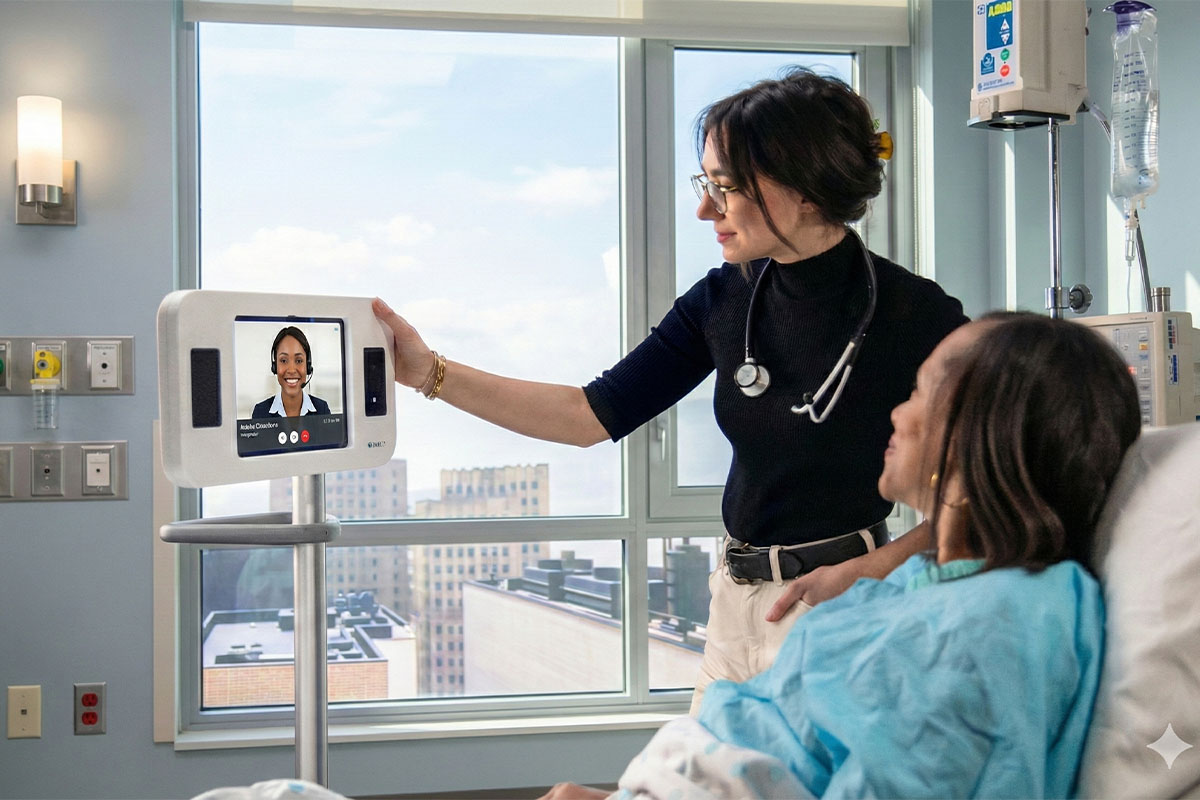
Why Purpose-Built Solutions Outperform “Good Enough” Hardware Over Time
The decision to purchase a tablet enclosure often starts with a simple question: how much does it cost?
That question is understandable, especially when organizations are deploying across multiple locations or scaling a program like VRI, telehealth, or guest-facing tablets in hospitality environments. Hardware becomes a line item, and like most line items, there is pressure to keep it as low as possible.
But focusing only on upfront cost is a narrow view of what these systems actually represent. Tablet enclosures are not decorative accessories or passive holders. They are part of the operational infrastructure. They support workflows, enable communication, and in many cases, directly influence the experience of patients, staff, and customers.
When evaluated through that lens, the more relevant question is not what a tablet enclosure costs to buy, but what it costs to own over time.
Total Cost of Ownership Is What the Real Story Is
Total Cost of Ownership, or TCO, expands the evaluation beyond the purchase price and into the full lifecycle of the product. It accounts for how the enclosure performs under real conditions, how often it needs to be repaired or replaced, and how much effort is required to keep it functioning properly.
In environments like healthcare and VRI, those variables are not theoretical. They show up quickly and often. Devices are used continuously. They are cleaned frequently. They are moved, adjusted, and relied on throughout the day. Any weakness in the enclosure becomes visible in short order.
What looks like a cost-effective decision at the outset can begin to erode under the weight of daily use. A lower-cost enclosure may save money upfront, but if it introduces friction into the workflow, requires frequent intervention, or fails prematurely, the long-term cost profile changes dramatically.
Where Generic Enclosures Begin to Erode Profitability
Generic tablet enclosures are designed to be broadly compatible. That flexibility is appealing, especially for organizations that are still defining their use cases. But broad compatibility often means compromise.
Materials are typically chosen to meet a general standard rather than the demands of a specific environment. A purpose-built locking tablet stand eliminates the security compromises that generic enclosures introduce, keeping devices secure without adding operational friction. In clinical settings, where devices are wiped down repeatedly and handled by multiple users throughout the day, those materials begin to show wear. Hinges loosen. Mounting points degrade. Stability becomes inconsistent.
Industry patterns suggest that lower-grade enclosures in high-use environments can require replacement in as little as 12 to 18 months. That replacement cycle is not just a hardware issue. It introduces a recurring operational burden. Devices need to be removed, reinstalled, and tested. Staff time is redirected to address something that should have been stable from the beginning.
The impact extends beyond durability. Generic enclosures rarely account for the full context in which they are used. Cable management is often an afterthought, leading to exposed wiring or improvised solutions. Audio is not considered, which becomes a problem in VRI and telehealth scenarios where clear communication is essential. Mounting systems may technically work, but they are not optimized for the way the device is actually used throughout the day.
The result is a series of small inefficiencies. Individually, they may seem manageable. Collectively, they create friction that slows down workflows and increases the time required to maintain the system.
The Compounding Cost of Downtime and Workarounds
One of the most overlooked aspects of TCO is downtime. When a tablet enclosure fails or needs adjustment, the disruption is rarely isolated to the device itself.
In a VRI setting, a malfunctioning cart can delay communication between a patient and a provider. In a telehealth scenario, it can interrupt a consultation. In hospitality, it can slow down check-in or service interactions. For guest-facing applications, a purpose-built tablet kiosk eliminates the downtime and workarounds that erode ROI in high-traffic environments. These are not edge cases. They are daily touchpoints.
Even short disruptions accumulate. A few minutes here and there, repeated across devices and locations, translates into hours of lost productivity over the course of a year. More importantly, it introduces variability into processes that are meant to be consistent.
Workarounds add another layer of cost. When an enclosure does not fully support the application, teams adapt. They reroute cables, add external components, or modify mounting configurations. These adjustments require time to implement and maintain. They also introduce new points of failure.
Over time, the system becomes more complex than it needs to be, not because of the core technology, but because the hardware supporting it was not designed with the full use case in mind.
Why Purpose-Built Enclosures Shift the Economics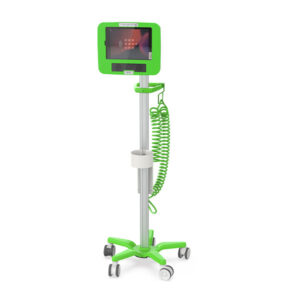
Purpose-built tablet enclosures take a different approach. Instead of trying to accommodate every possible scenario, they are designed around specific applications and environments. That focus allows them to eliminate many of the inefficiencies that drive up total cost over time.
In healthcare and VRI applications, material selection is not just about durability. It is about consistency under repeated cleaning and continuous use. Enclosures built with healthcare-grade materials maintain their integrity longer, reducing the frequency of replacement and the need for ongoing adjustments.
Design also plays a critical role. When cable management is integrated into the enclosure, there is no need for external fixes. When audio considerations are built into the design, communication remains clear without additional components. When mounting and mobility are engineered for the workflow, the device becomes easier to use rather than something that needs to be managed.
This is where solutions like Padholder’s VRI cartsdemonstrate their value. They are not simply stands for a tablet. They are designed specifically for language interpretation, where positioning, mobility, and audio all need to work together seamlessly.
The same principle applies to medical cartswhich are built for clinical environments where durability, hygiene, and usability are critical. The enclosure is part of the workflow, not an accessory attached to it.
What a 250-Unit Clinical Rollout Really Costs Over 3 Years
In clinical, VRI, and telehealth environments, the lowest upfront price rarely tells the full story. A generic tablet enclosure may cost less on day one, but replacement cycles, reinstallation, maintenance, downtime, and workflow disruption can quickly change the economics.
Model Assumptions
$185,000
Total estimated 3-year cost
| Cost Category | Calculation | Total |
|---|---|---|
| Initial hardware | 250 × $150 | $37,500 |
| Replacement hardware | 250 × $150 | $37,500 |
| Install + reinstall labor | 250 hrs × $35 | $8,750 |
| Maintenance + workarounds | 750 hrs × $35 | $26,250 |
| Downtime impact | 1,500 hrs × $50 | $75,000 |
$108,438
Total estimated 3-year cost
| Cost Category | Calculation | Total |
|---|---|---|
| Initial hardware | 250 × $300 | $75,000 |
| Replacement hardware | Not required | $0 |
| Installation labor | 125 hrs × $35 | $4,375 |
| Ongoing maintenance | 187.5 hrs × $35 | $6,563 |
| Downtime impact | 450 hrs × $50 | $22,500 |
Why the Gap Matters
The generic option appears less expensive upfront, but it carries hidden costs across the full deployment. Replacement hardware, reinstallation labor, field adjustments, cable workarounds, and downtime all scale with every unit. In a 250-unit clinical rollout, those small operational issues become meaningful budget impact.
Purpose-built tablet enclosures reduce those costs by designing around the application from the beginning. For VRI carts, medical carts, and telehealth workflows, that can include cleaner cable routing, stronger mounting, better device positioning, integrated audio considerations, and materials intended for high-use clinical environments.
Planning a clinical, VRI, or telehealth rollout?
Padholder builds purpose-built tablet enclosures, medical carts, and VRI carts designed for real-world use at scale.
Request a QuoteCustomization Without the Traditional Tradeoffs
Customization is often associated with higher costs and longer timelines. That perception comes from industries where custom work is inherently manual and difficult to scale.
In the context of tablet enclosures, that does not have to be the case.
One of the differentiators in Padholder’s approach is the ability to deliver custom solutions at a cost that remains practical for larger deployments. Customization goes beyond surface-level changes like color. It extends to how the enclosure functions within a specific application.
That can include integrated wire management, accommodation for different device configurations, or the inclusion of components like speakers that are critical to the use case. The goal is not to create something unique for the sake of it, but to ensure that the enclosure aligns precisely with how it will be used.
Because this level of customization is built into the manufacturing process, it does not introduce the same cost penalties that are typically associated with bespoke solutions. Organizations can deploy purpose-built hardware at scale without sacrificing efficiency or budget control.
A More Realistic View of Long-Term Value
When comparing a generic enclosure to a purpose-built solution, the difference is not just in the initial price. It is in how the product behaves over time.
A generic enclosure may require multiple replacements within a three-year period, along with the associated labor and downtime. A purpose-built enclosure, designed for the environment and application, is more likely to remain in place and perform consistently throughout that same period.
The financial implications are straightforward, even without precise numbers. Fewer replacements mean lower capital expenditure over time. Reduced downtime means more consistent operations. Less need for workarounds means lower labor costs and fewer points of failure.
What starts as a higher upfront investment becomes a more stable and predictable cost structure.
Why This Matters More in VRI and Telehealth
In VRI and telehealth applications, the role of the tablet enclosure is elevated. It is not simply supporting a device. It is enabling communication that is central to the service being delivered.
Any disruption has a direct impact on the experience of the people involved. For patients, it can mean delays or frustration. For providers, it can mean interruptions in care. For organizations, it can mean inefficiencies that ripple through the system.
Purpose-built enclosures reduce that risk. They ensure that devices are positioned correctly, that audio is clear, and that movement between spaces is smooth and reliable. These are not enhancements. They are foundational requirements for the application to function as intended.
Shifting the Decision Framework
Evaluating tablet enclosures through the lens of total cost of ownership requires a shift in perspective. It means looking beyond the immediate expense and considering how the product will perform in the context of daily use.
Price remains an important factor, but it is no longer the only factor. Durability, reliability, and alignment with the application become equally important because they directly influence long-term cost.
A lower-cost option that introduces friction and requires ongoing attention is not a savings. It is a delayed expense that will surface over time. A purpose-built solution, even with a higher upfront cost, often delivers a more efficient and predictable outcome.
Request a Quote
If you are planning or expanding a VRI, telehealth, or medical deployment, it is worth evaluating tablet enclosures based on how they will perform over time, not just how they are priced today.
Purpose-built solutions can reduce total cost of ownership while improving reliability and user experience across the board.
Request a quote to explore a configuration designed specifically for your application.
